
Inverse Trigonometric Functions Case Study Questions With Answers
Inverse Trigonometric Functions Case Study Questions With Answers help students practice application-based mathematical problems designed according to the latest CBSE board examination pattern. These questions improve conceptual clarity and strengthen logical reasoning skills. Moreover, case-based learning allows students to understand how inverse trigonometric identities work in different mathematical contexts.Students often find interpretation-based questions challenging. Therefore, regular practice becomes essential for improving analytical thinking. Educational platforms such as mathstudy.in provide structured mathematics resources that support systematic preparation.In addition, learners can explore free educational materials at Udgam Welfare Foundation. These resources help strengthen conceptual understanding and improve exam readiness.With consistent practice and proper guidance, students gradually gain confidence while solving competency-based mathematics questions. Consequently, they perform better in board examinations.
Importance of Case-Based Mathematics Practice
Case-based questions improve reasoning ability. Furthermore, they strengthen conceptual clarity. As a result, students understand mathematical applications more effectively during examinations.
Case Study 3: Math Case Study Inverse Trigo Functions
In a high-school robotics club, students are building a robotic arm that can pick up a ball. The arm has two main parts that move at different angles. To move the “hand” of the robot to a specific spot on the table, the students use a computer program. The program needs to calculate the angle of the joints based on the distance. This is called “Inverse Kinematics.” For example, if the arm needs to reach a height y and a distance x, the program uses the formula θ = tan⁻¹(y/x).
The students must be very careful because the robot’s motor can only turn within a certain limit. This is just like the “Principal Value Branch” in math. If the math gives an angle that the robot cannot reach, the arm might crash or get stuck. One student notices that when the arm moves backwards, the values become negative. They must understand the range of functions like sin⁻¹x, cos⁻¹x, and csc⁻¹x to make sure the robot moves smoothly. By using simple identities and properties, the students can combine different movements into one single calculation, making the robot faster and smarter at its job.
Recommended E-Book for Class 12
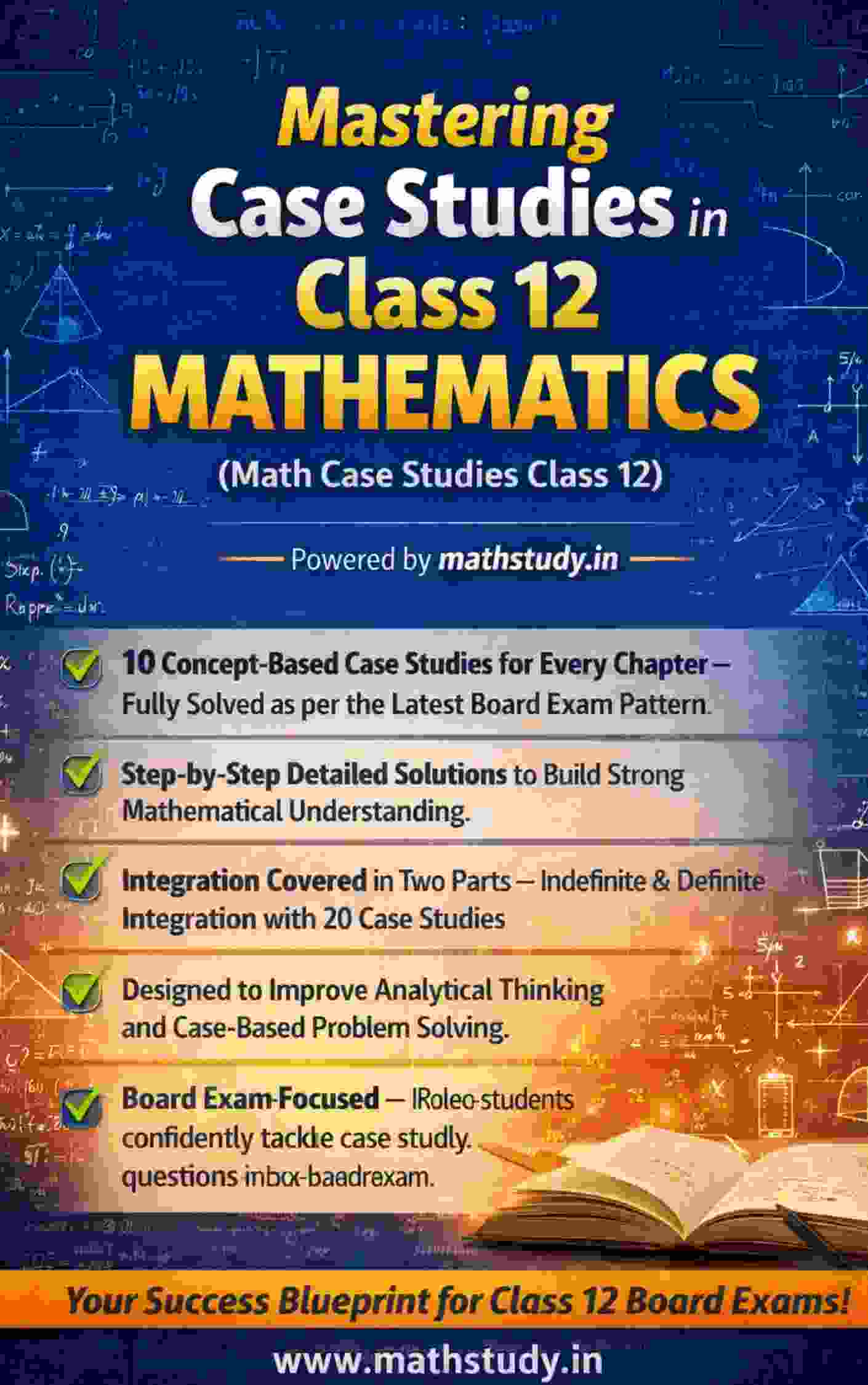
Math Case Studies Class 12
Frequently Asked Questions (FAQs)
What are inverse trigonometric case study questions in Class 12 mathematics?
Inverse Trigonometric Functions Case Study Questions With Answers help students understand how inverse trigonometric identities work in practical mathematical situations. Moreover, these structured problems improve conceptual clarity and analytical thinking required for CBSE board examinations.
Why should students practice case study questions on inverse trigonometric functions?
Case study questions encourage students to analyze mathematical expressions carefully. Therefore, learners develop logical reasoning skills and better conceptual understanding. In addition, practicing these questions regularly improves accuracy in solving board exam problems.
Where can students find reliable inverse trigonometric case study resources?
Students can explore well-organized mathematics study material on mathstudy.in. Additionally, Udgam Welfare Foundation provides several free academic resources that support consistent learning and board exam preparation.
How do solved case study questions help in understanding inverse trigonometric identities?
Solved case study questions explain each step of the mathematical solution clearly. Consequently, students understand domain restrictions and identity transformations more effectively. Furthermore, regular practice builds confidence while solving complex inverse trigonometric expressions.
What strategy should students follow to master inverse trigonometric functions?
Students should first revise theoretical concepts and identities thoroughly. Then they should solve structured case study questions regularly. Moreover, using guided resources from mathstudy.in helps improve analytical ability gradually.